I sleep well. My Oura ring has scored 2,030 of my nights over the past five and a half years, and across the last twelve months the average is 80, which the app files under “good.”
What I had was a set of superstitions. Every dinner that ran past 8 p.m., I wondered whether I’d pay for it in recovery. I suspected that staying out late with friends came with a high price tag on sleep, but couldn’t have said how much. The ring was no help with any of this. It could grade a night in fine detail, but it knew nothing about the day that came before it or how I was actually feeling.
In mid-June I started supplying the other half. Five months and 138 nights later, I went through those beliefs systematically. One held, with a sharper edge than I’d guessed. One had been hiding behind the wrong number. One was simply false.
It’s all about the friction
Oura does have a feature for recording unstructured data about what you did: tags. Logging one takes about eight taps, and once it’s logged there is very little you can do with it. I tried several times and never kept it up. The things I most wanted on the record, such as how much I’d had to drink, how my back felt and whether I had any energy, had nowhere to go at all.
What finally worked was talking. I built an app, Cohearence, that lets me say a sentence to my watch, phone, or laptop. This is a complete log from my wrist, start to finish:
Or a similar log in the browser:
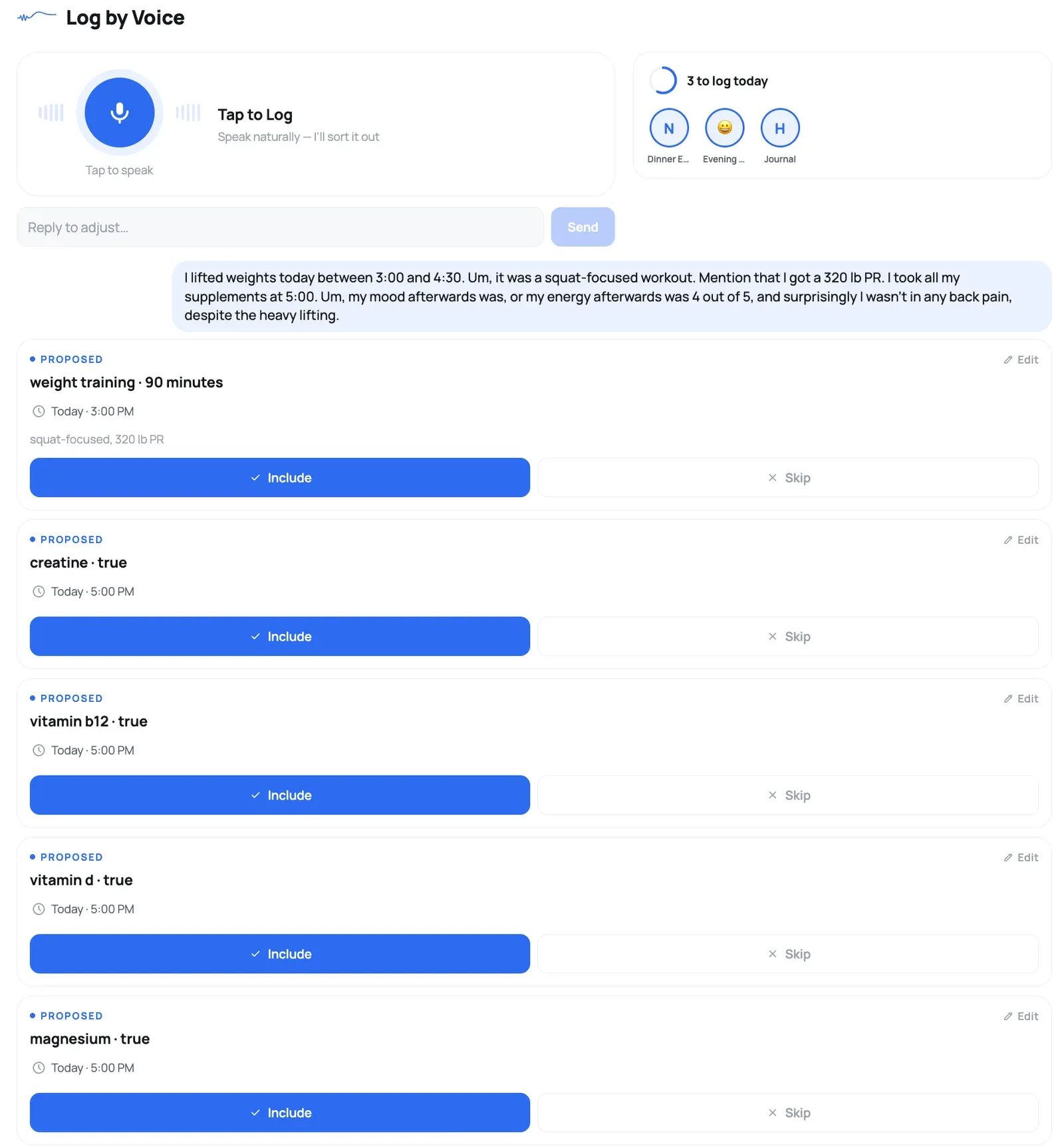
A small language model turns the sentence into structured measurements and shows me what it understood. The workout’s duration is inferred from the two times I gave, and “all my supplements” becomes the supplements I actually take. I include or skip each entry, and it’s saved.
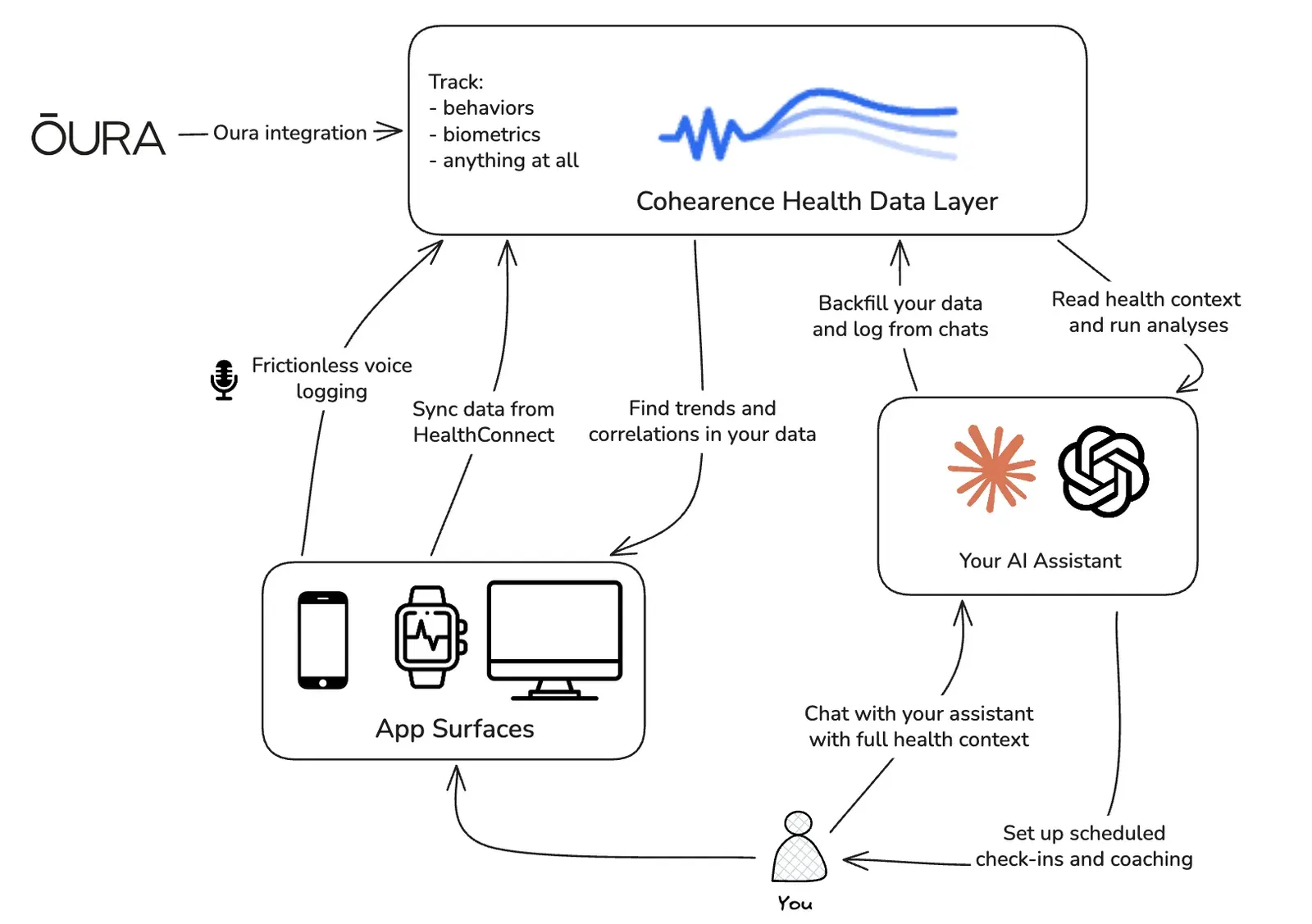
Those entries land beside the data from my Oura Ring and smart watch. The app can then test which metrics move together, and so can an AI assistant such as Claude.
The app’s main analytical view is called Signal. Pick a metric and it draws everything that reliably moves with it, after correcting for the hundreds of pairs it had to test. Here is my Readiness score. Green lines move together, red lines move in opposite directions, and thicker lines are stronger.
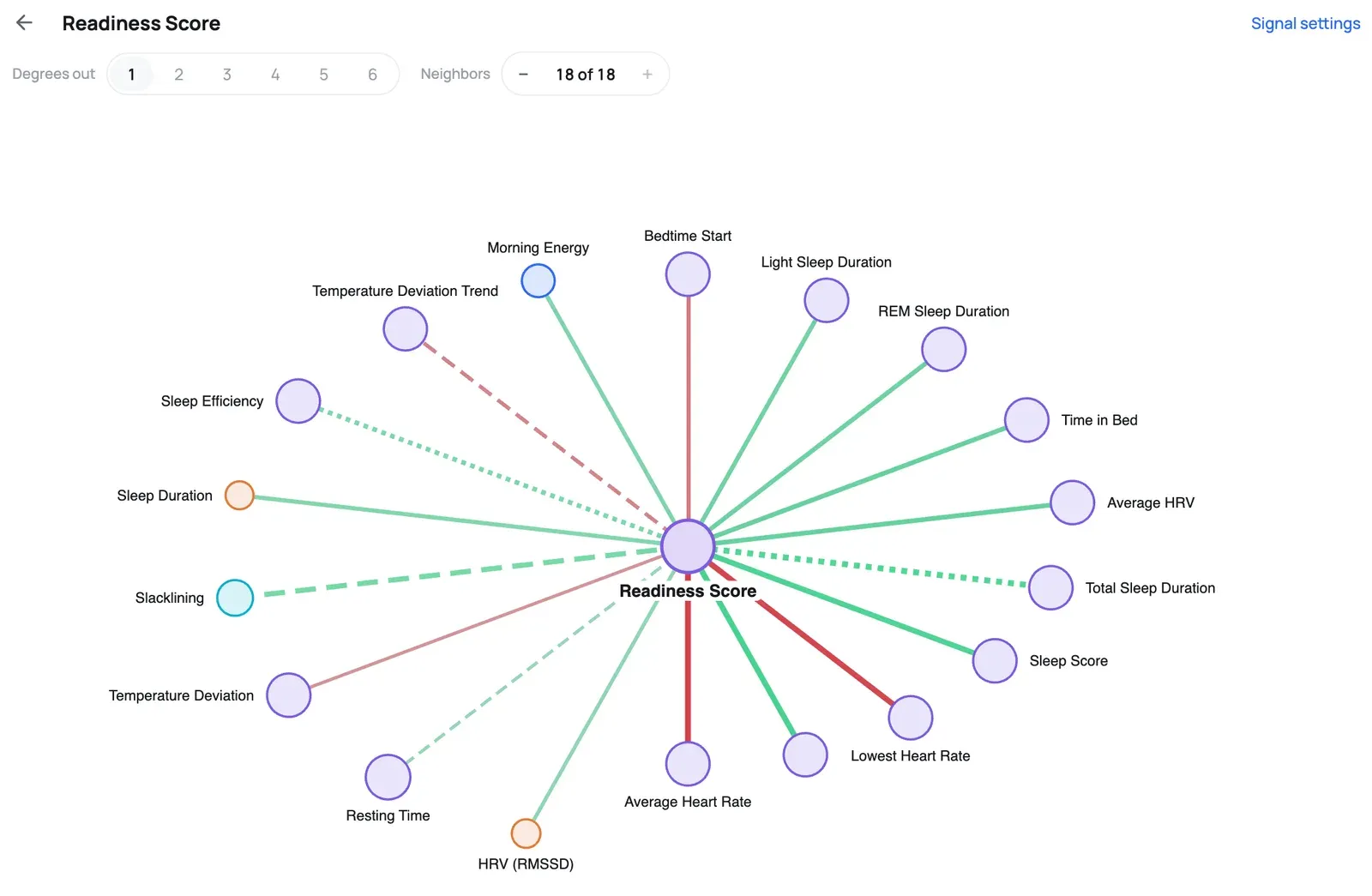
Most of this is the ring agreeing with itself. The interesting lines are the ones that cross over to metrics that I log myself, like morning energy at the top.
Dinner time doesn’t meaningfully impact sleep
On nights when dinner ended at 8 or later, I averaged 1.08 hours of deep sleep. On earlier nights it was 1.14, a gap well inside the noise. Across 86 nights, the correlation between the time I finished eating and the deep sleep that followed was −0.01.
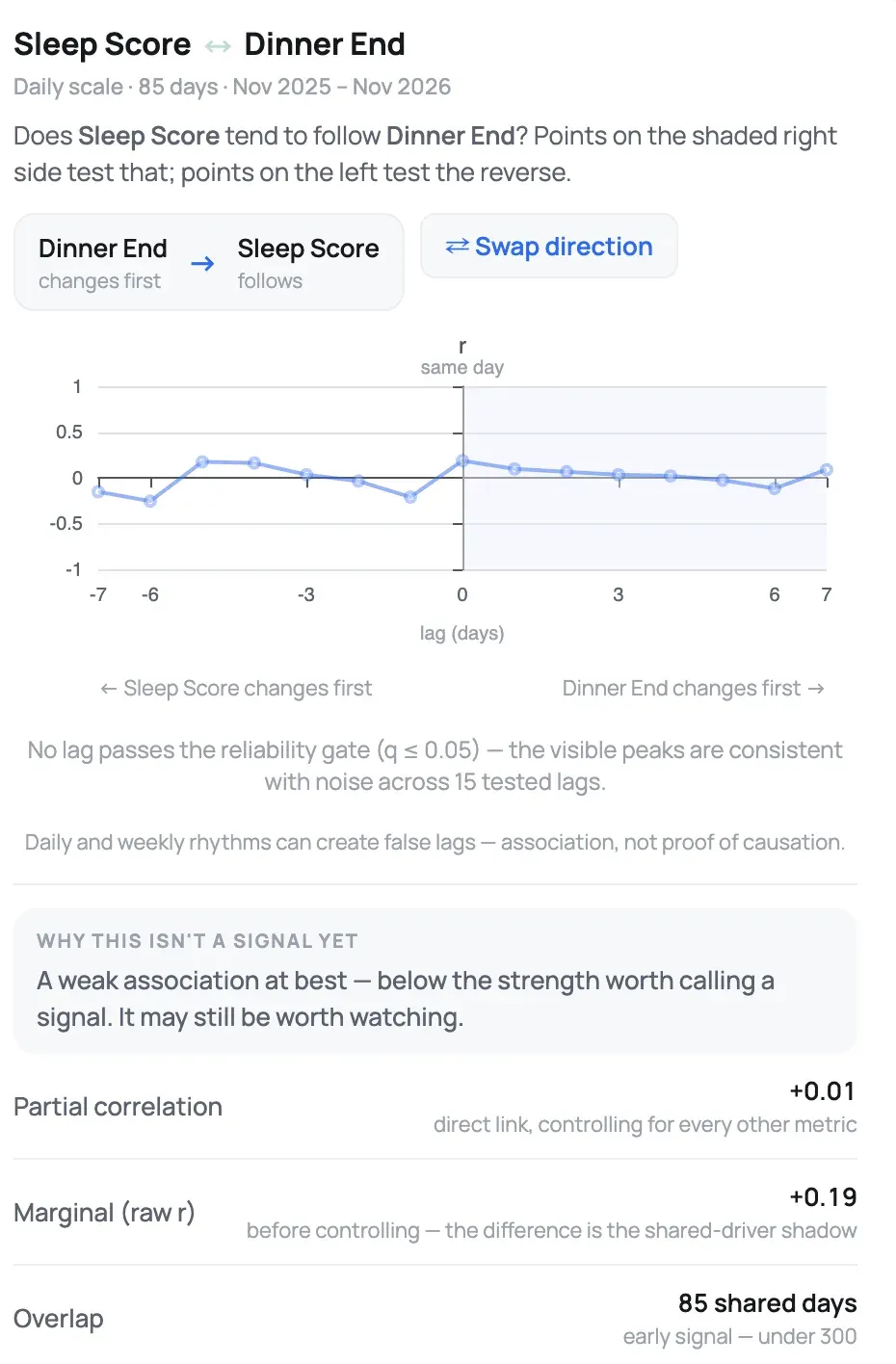
This view makes it easy to show that there’s no reliable signal between these metrics.
But bedtime’s impact is huge
I knew going to sleep earlier was positive in theory, but I’ve always considered myself a bit of a night owl and thought my body responded well to late nights. I was mistaken:
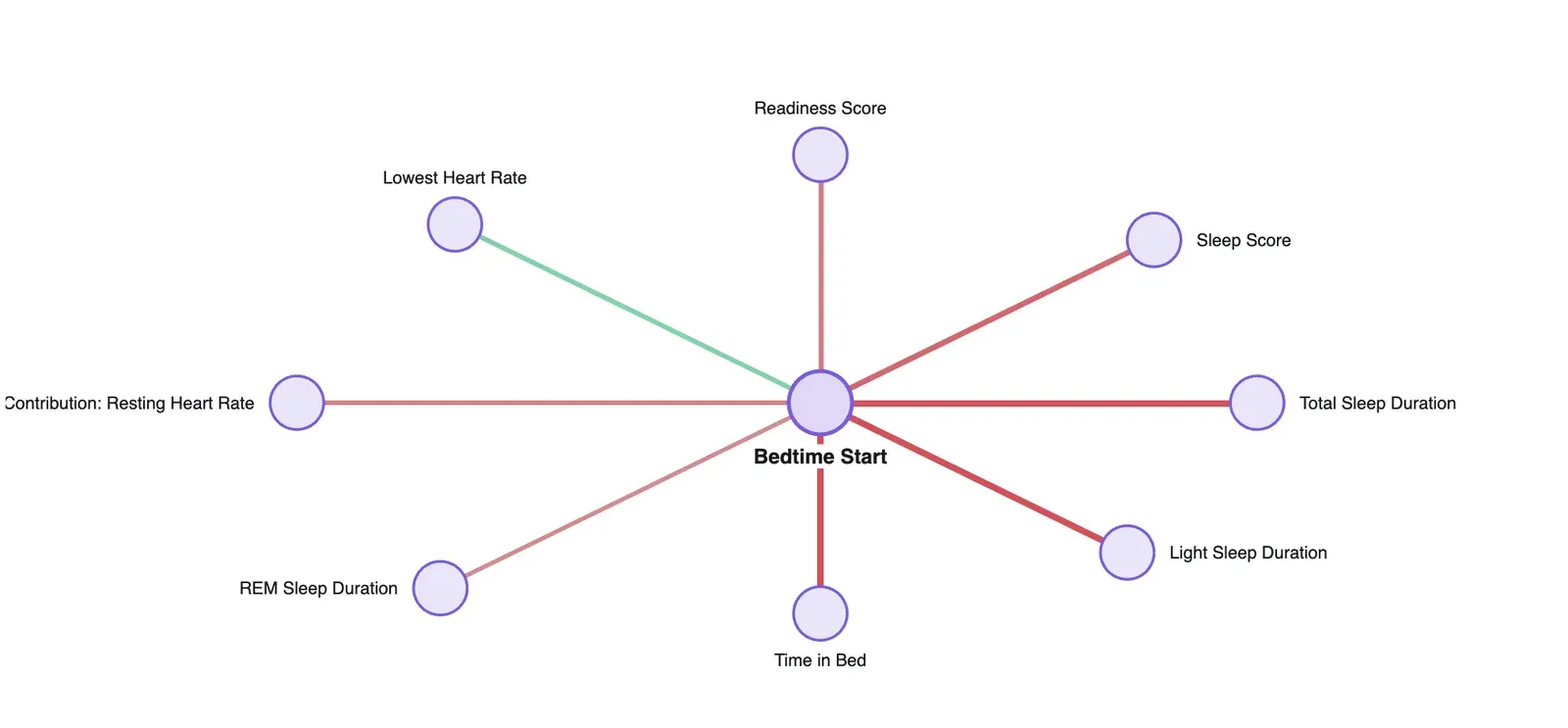
Nearly every line is red. Across all 138 nights, going to bed later went with a lower Sleep Score (a correlation of −0.40) and lower Readiness the next morning (−0.32). What’s more interesting is visualizing how the impacts vary by hour:
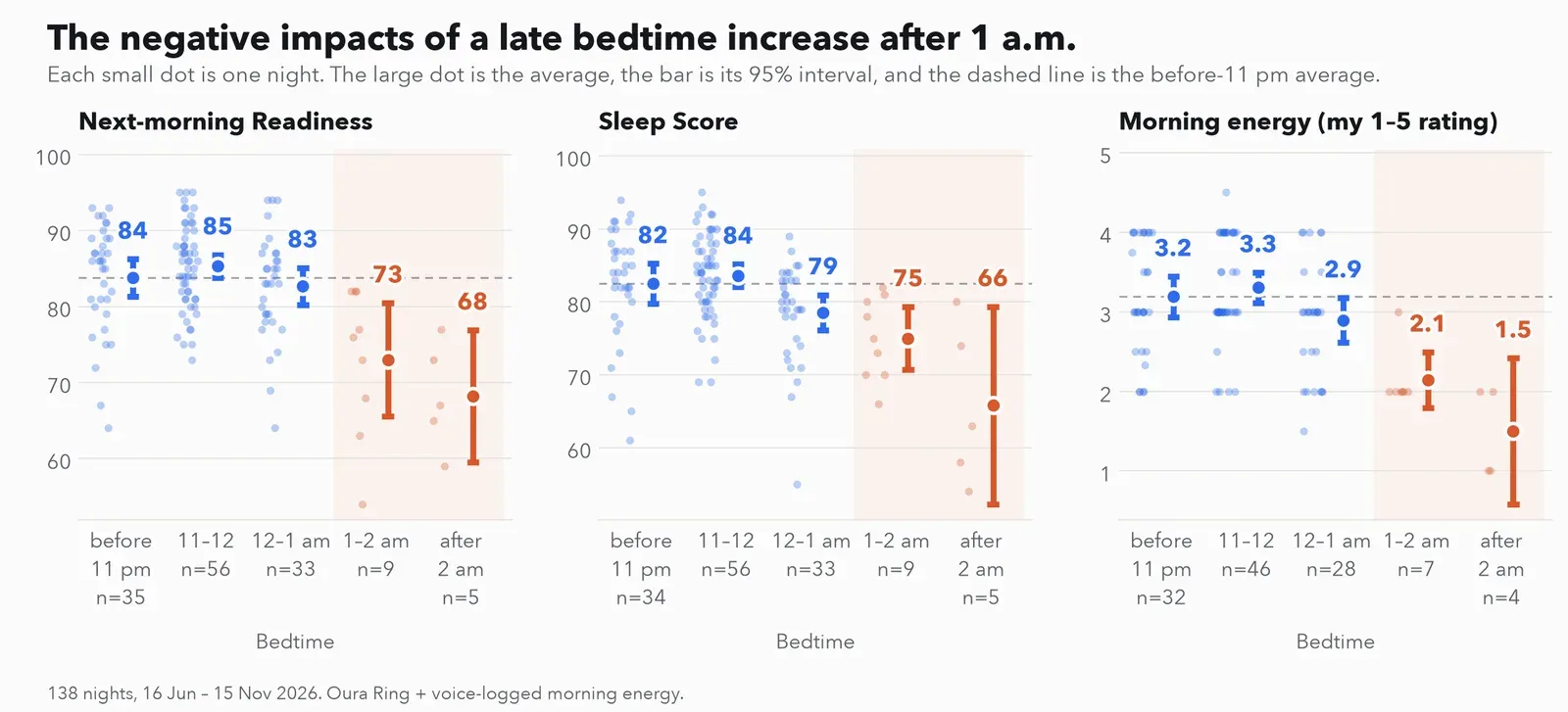
Before 11 p.m. and between 11 and midnight are indistinguishable. Midnight to 1 a.m. costs me one Readiness point. Then the floor drops: 73 for nights that began between 1 and 2, and 68 after 2. Oura builds its scores partly out of sleep timing and duration, so correlating these two variables is a bit circular. My morning energy rating is not, and it falls the same way, from 3.2 to 2.1 to 1.5.
Take out the fourteen nights that started at 1 a.m. or later and the Readiness correlation drops by half, to −0.15. For me the relationship is a ledge rather than a slope, and the ledge sits at about 1 a.m.
Those fourteen nights were not a random sample. Five involved alcohol and four were concerts or parties, so I asked Claude to pull the raw nights and fit a regression with drinks and concerts alongside bedtime. Bedtime kept nearly all of its effect: about two Readiness points and a quarter-point of morning energy for each hour later. Fourteen nights can’t establish cause. They were enough to retire “it was just the drinking.”
I always knew late nights were bad for my health, but I never drew much of a line between 11 p.m. and 3 a.m. Now I try to avoid the tail: I still go out, and I still stay up past midnight when the evening is worth it, but I do so knowing the price I’ll pay when I get home after 1 a.m.
Keep it under 3 drinks
If you had asked me in June which number would show the effect of alcohol, I’d have said the Sleep Score. On nights after drinking it averaged 80. On other nights it averaged 81.
The effect was in the other numbers. After any drinking, my overnight heart rate variability averaged 105 milliseconds against 115, and next-morning Readiness averaged 78 against 84. Sorted by amount, it has the same shape as bedtime.
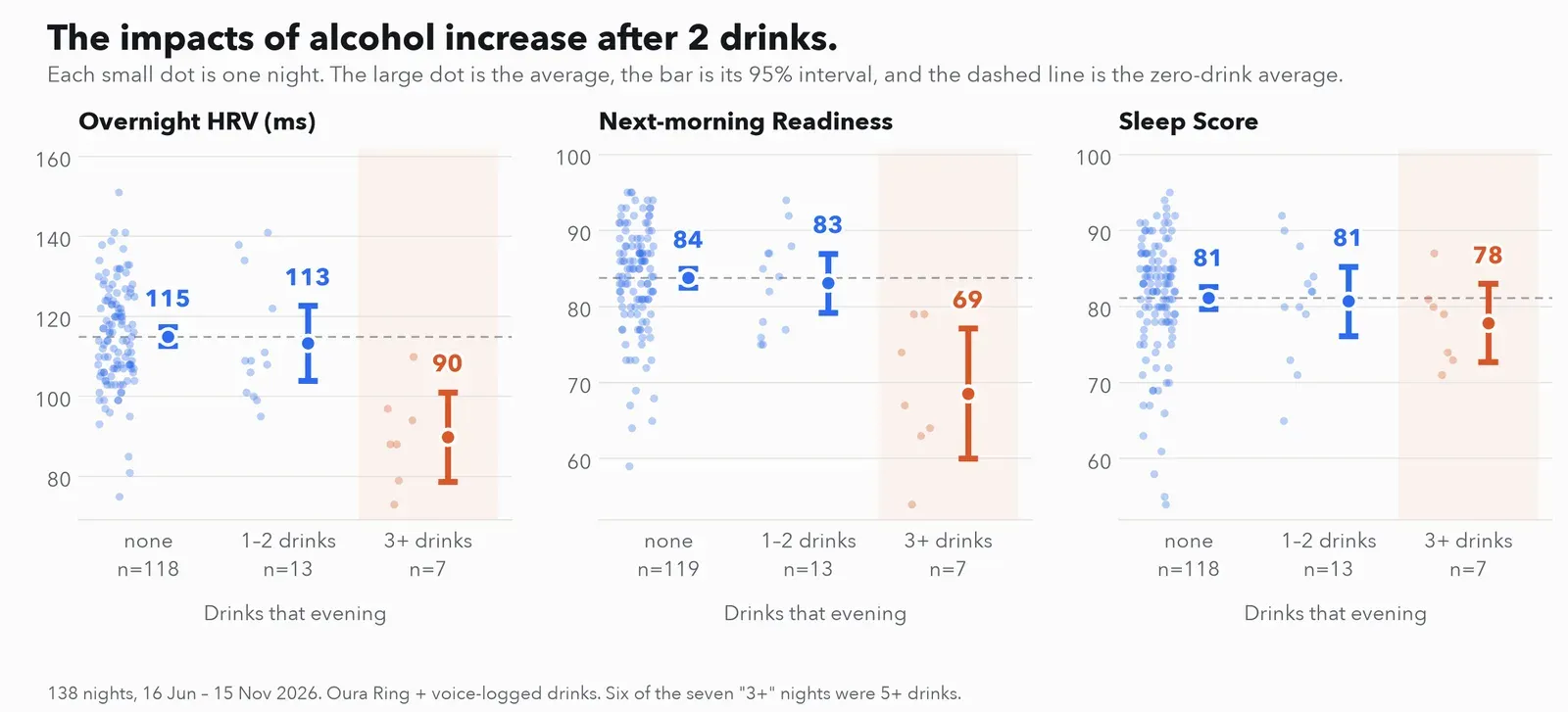
One or two drinks look like none. The seven heavy nights cost me 25 milliseconds of HRV and 15 points of Readiness, while the Sleep Score slipped to 78, which Oura still calls good. I can’t place the line more precisely than somewhere between two and five drinks, because nearly all of those heavy nights were five or more. In the same regression, alcohol kept its own effect on Readiness with bedtime held fixed, and had none at all on Sleep Score.
What I changed is similar to bedtime. I haven’t stopped drinking. If anything I’m more relaxed about a casual beer when I’m out with friends. But I’m much less likely to have a third, now that I’ve seen what my numbers do past that point.
Correlating my subjective experience with my biometrics
Three times a day I tell my watch how much energy I have, something that no sensor can record on its own.
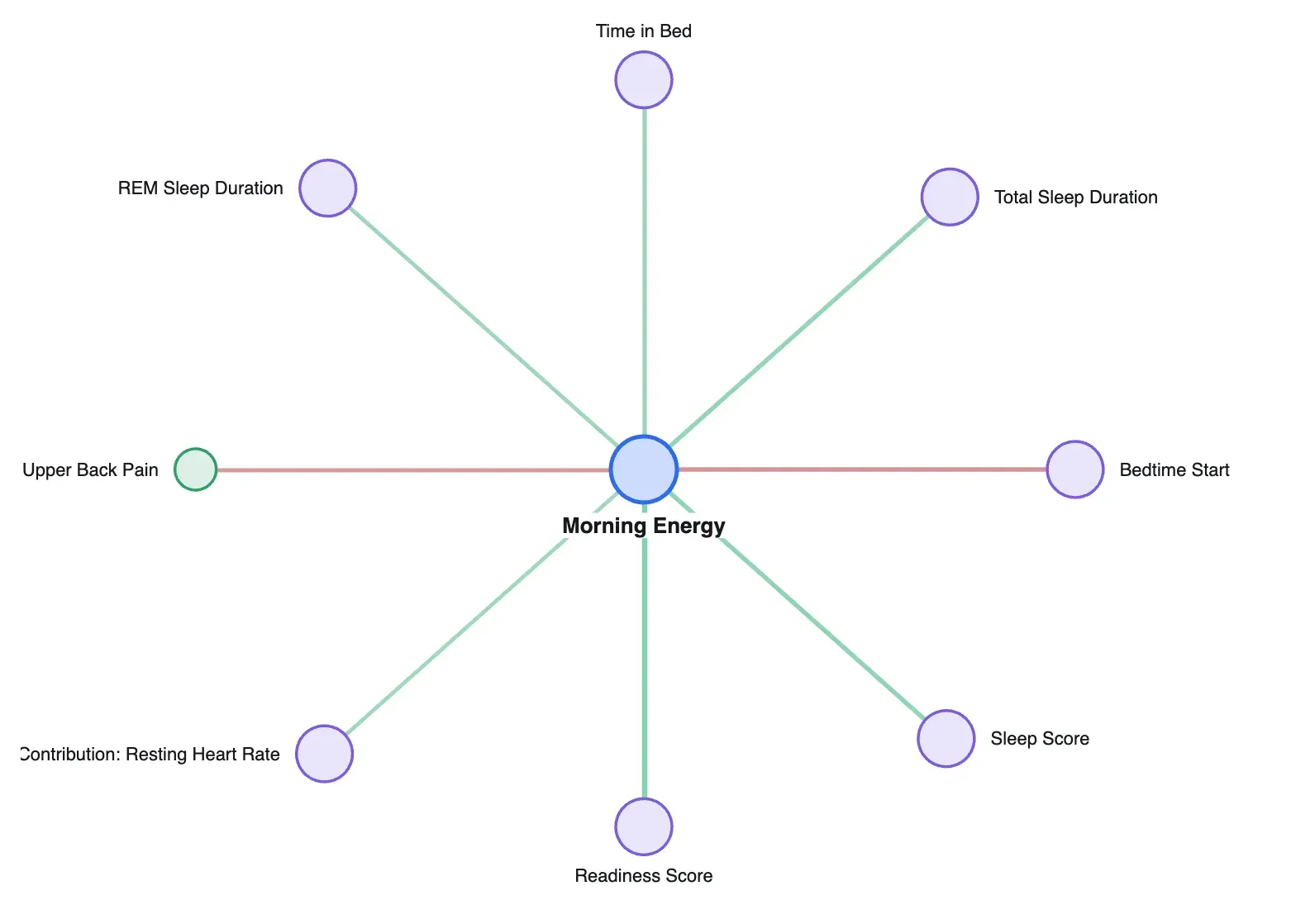
In the morning, the ring and I loosely agree. Its Readiness score is the strongest link to my own rating, with a correlation of 0.45. Bedtime shows up again in red. So does upper back pain, which I did not expect. My hypothesis is that back pain impacts my mood most in the morning becaus muscles are tightest early in the day.
My afternoon energy follows a completely different pattern that has nothing to do with sleep. The Analysis page looks closely at one metric at a time, including a breakdown by day of the week.
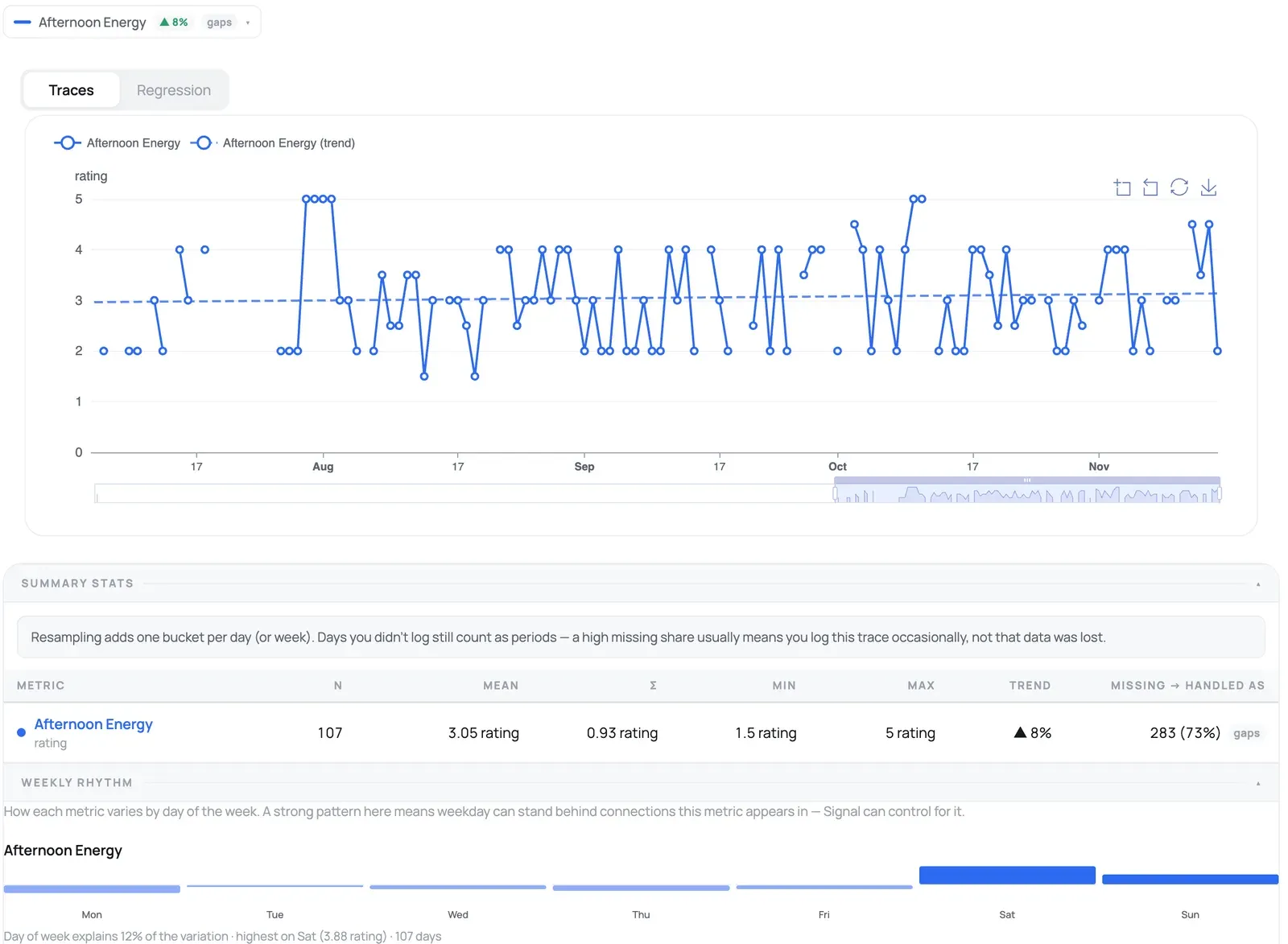
The strip at the bottom is the finding. My afternoon energy averages 2.84 on weekdays and 3.75 on weekends, and the day of the week alone accounts for 12 percent of the variation. Mornings show no such gap (3.05 against 3.08) and neither do evenings.
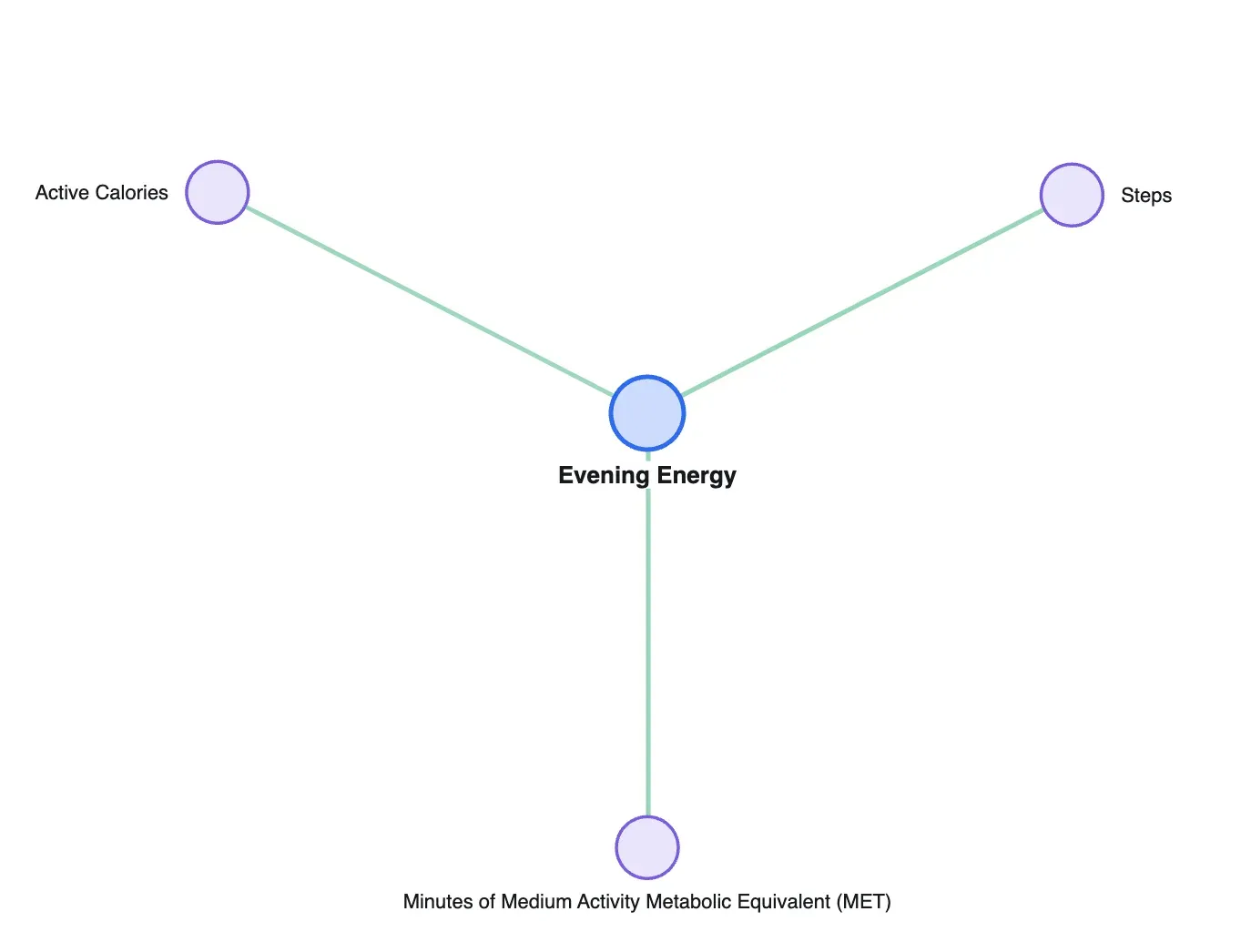
My evening energy is strongly influenced by movement. Active calories, steps and minutes of moderate activity are the only three things linked to how I feel at night. On afternoons when I’m exhausted from work and just want to go home and lie on the couch, I often convince myself to go to the gym knowing that it’s the most reliable way to impact my energy for the rest of the evening.
What’s most interesting to me is that none of these mood measurements are correlated with each other; I would have guessed that the strongest predictor of how I felt in the evening would be how I felt in the morning – that some days are “just good” or “lousy”. Instead, each part of the day follows its own formula: morning is influenced primarily by sleep, afternoon by work, and evening by activity. I find motivation in this: it helps provide a toolkit for what to do depending on the time of day to improve my mood.
Tracking just what I need
I’ve been into lifting weights for years, but have never routinely tracked my progress. I’d always forget to bring the notebook I was using when I tried tracking by hand, and I found apps like Hevy to require way too much interaction to use properly – I’d spend all of my time between sets on my phone and not locked in for the workout.
All I really need to track for my key lifts is my maximum weight per session. Now, between sets, I just tap my wrist and say what I lifted, and go back to the bar.
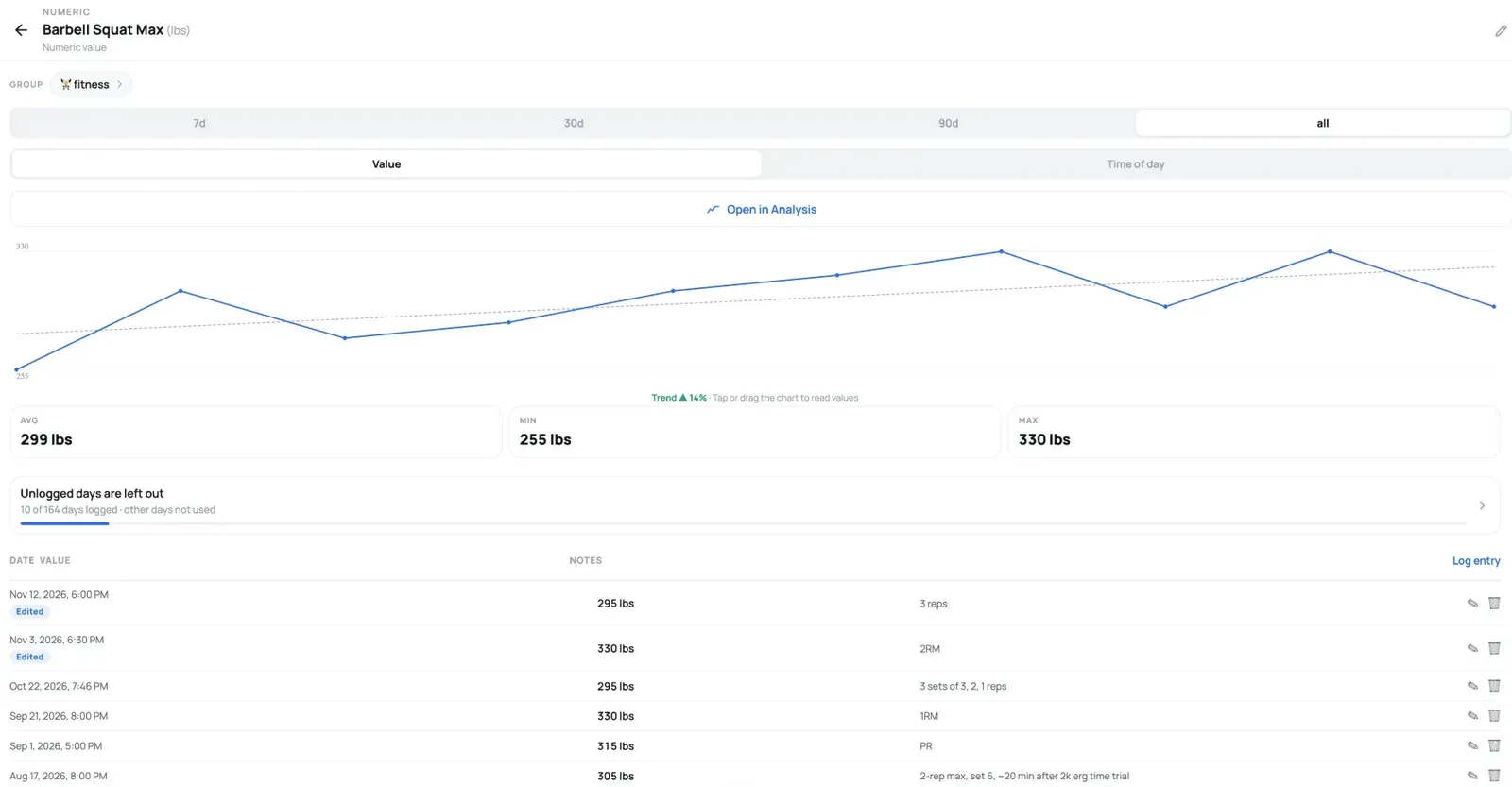
That is ten entries over five months, from 255 pounds to 330.
Coach Claude
Everything I’ve covered so far requires me to proactively use the app to log or analyze data. But the primary way Cohearence impacts my daily life is as a database for my AI assistant.
I have a scheduled Claude task that reads my data every morning and writes me a check-in with recommendations for how to structure my workouts and recovery and a rough plan. At this point, it has months of data and conversations in its context, and it’s able to find connections that I sometimes miss. This is a real message from early October. I was getting over a cold after three days at the Austin City Limits (ACL) festival:
The cold is officially resolved — you logged sickness at 1 last night with the note “Recovered.” … HRV hit 151ms Tuesday night, the best reading of the entire month.
You haven’t done a heavy lift since the kettlebell session back on September 28th — nine days now … understandably given ACL and the recovery days after. Given tonight’s numbers (Readiness 83, HRV at its best, back trending down, cold gone) … Today would be a good day to get back under a bar.
You’ve now had back-to-back examples of your back handling real, varied physical stress well — ACL’s three days of walking and dancing, and now a trail run — while only reacting sharply to one specific trigger so far, the unfamiliar demands of live Jiu-Jitsu rolling. … If you want to try BJJ again, easing in with drilling-only sessions before live rolling … is probably the right way back in.
That message draws on my Oura Ring’s HRV and Readiness, my own back-pain ratings, journal entries about a music festival, and a previous mention of an injury from a jiu-jitsu class two weeks earlier. No other app I’ve used can pull together context from such disparate areas of my life.
I deliberately didn’t build a chatbot into Cohearence. I already use Claude as an assistant for many other areas of my life. Cohearence is built to plug into that ecosystem rather than compete with it.
Limitations
I am one person, with 138 nights of data. I ran 96 comparisons to write this and corrected for having run that many. What I’ve called a finding survived the correction, and what didn’t, I’ve tried to label as such.
Trying it out yourself
Cohearence runs on the web and on Android, and syncs with Oura and Health Connect. The Wear OS watch app I’ve been using is still a prototype, with a public release on the way. If you’d like to try out any of the tools I’ve demonstrated, it’s free to start understanding your data: cohearence.app.
As for me, my current schedule clearly leaves me tired in the afternoon, so I’m playing around with shaping my workday a little differently, with a break and workout in the middle of the day rather than after work. I’m curious to see what effect this will have!
Cohearence is free to start. You can try it on your own data.
Get started free